




ENT Urgent Care

Hearing

Allergy

Sinus

Sleep




Hearing loss doesn’t just mean someone needs to turn up the TV or ask “Can you repeat that?” It has also been linked to an increased risk of dementia.

The doctors at Midwest ENT & Allergy know parents have concerns when their child seems to be suffering. Dr. Todd provides answers to six common questions parents have when it comes to testing kids for allergies

Balloon Sinus Dilation FAQs
 Frequently Asked Questions
What is in-office balloon sinus dilation?
Balloon sinus dilation is a minimally invasive treatment for chronic or recurrent sinusitis. In a balloon sinus dilation procedure, your physician uses a small balloon to dilate or expand the sinus opening and drainage pathways to restore sinus drainage.
Balloon sinus dilation can be performed in an office, under local anesthesia.
How does balloon sinus dilation work to treat chronic or recurrent sinusitis?
In chronic and recurrent sinusitis, blocked sinus drainage pathways can prevent effective drainage and healing. When first line medication therapies fail to resolve symptoms and inflammation, or patients experience multiple bouts of sinusitis, balloon sinus dilation may be an appropriate treatment option.
The goal of balloon sinus dilation is to expand the sinus openings and drainage pathways in order to aid drainage and promote healing. After locating the treatment area and applying local anesthesia, your physician will place the small balloon, inflate the balloon to dilate the treatment area, and then deflate and remove the balloon.
How long does the balloon sinus dilation procedure take?
Procedure length is dependent on your specific condition and anatomy. You should expect to spend around one and a half to two hours at the office, to allow time for pre-treatment preparation and post-treatment examination. Consult your physician to better understand the details of your procedure.
What are the benefits of an in-office balloon sinus dilation procedure?
Office based procedures performed under local anesthesia allow you to avoid the negative effects, costs or risks associated with general anesthesia.
Will the procedure require any anesthesia?
Balloon sinus dilation can be performed under local anesthesia, in an office.
In certain circumstances, balloon sinus dilation may also be used in combination with modern sinus surgery tools. In these instances, it may be performed in an operating room, under general anesthesia.
How quickly after treatment can I return to normal activities?
Many patients can resume normal activities immediately. Your doctor may recommend you refrain from very strenuous activities (such as heavy lifting) for a week after the treatment.
Are there any potential risks and complications associated with balloon sinus dilation?
As with any medical intervention, potential risks and complications exist with balloon sinus dilation. All patients should consult their doctors to determine if their conditions present any special risks. Your physician will review potential complications of balloon sinus dilation at consultation. Possible side effects include but are not limited to post-operative bleeding; pain and swelling; allergic reaction to anesthesia or other medications administered during the procedure; or infection. Your condition may not respond to this treatment.
Is balloon sinus dilation suitable for everyone?
Only your physician can tell you if balloon sinus dilation is a viable option to treat your sinusitis. Experience has shown that many patients with recurring or persistent sinusitis can be treated with balloon sinus dilation.
For more information on balloon sinus dilation, or office based sinus treatments, visit www.SinusSurgeryOptions.com.
Balloon Sinus Dilation
Sinusitis Treatment: Office Sinus Dilation now offered at Midwest Ear, Nose & Throat in our Sioux Falls office
Balloon Sinus Dilation
Frequently Asked Questions
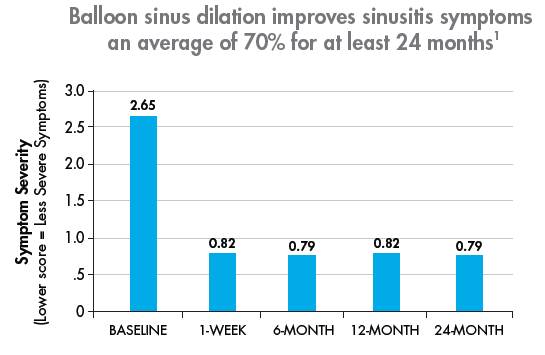
Sinusitis sufferers – find instant relief that lasts
Office sinus dilation is a minimally invasive option that can be performed by our physicians, right here in our offices. The goal of office sinus dilation is to reshape anatomy to expand sinus pathways and restore drainage.
The procedure utilizes small balloons placed in key places in the nose and sinus, which are then dilated to expand the sinus pathways. It may be an effective, lasting option for some patients whose symptoms do not resolve with medication.
The benefits of office sinus dilation include:
- Delivers instant, lasting relief
- Convenient, comfortable office procedure
- Quick recovery – most patients return to normal activity in 24 hours
- May reduce healthcare costs
Discuss office sinus dilation with your doctor at Midwest ENT today!
We are trained and experienced users of office sinus dilation technologies. Make an appointment at our Sioux Falls office today to determine if balloon sinus dilation is right for you.
Sinus Surgery
Minimally invasive functional endoscopic sinus surgery (FESS) can be considered if medical treatment fails, or if there is nasal or sinus obstruction that cannot be corrected with medications. FESS combines the most recent techniques and technologies, and is recommended for most sinus disease. Balloon sinuplasty is a new procedure that may be an excellent tool for frontal sinus disease. It also offers patients with limited disease an option for less invasive therapy.
How is sinus surgery performed?
With an endoscope, the surgeon looks at a magnified view of the internal nose on a television monitor, and while doing so, removes diseased tissue and polyps and clears the narrow channels between the sinuses. New image guidance systems allow our surgeons to achieve a much more complete removal of disease with much higher degree of safety. This is the safest way of doing things and allows for the most complete removal of disease.
What are the risks of surgery?
Although there are some risks involved with sinus surgery, we have performed thousands of cases without complication.
What does post-operative care entail?
Most patients can expect no restrictions on their diet or activity and can return to work as soon as they feel up to it.
What is Sinusitis?
Inflammation of the tissue lining the sinuses is called sinusitis. Sinuses are normally filled with air, but when sinuses become blocked and filled with fluid, germs, bacteria and viruses can grow and cause an infection. The common cold, nasal polyps, allergic reactions or a deviated septum are all conditions that may cause sinus blockage.
Different types of sinusitis include:
- Acute sinusitis: A sudden onset of cold-like symptoms such as runny, stuffy nose and facial pain that does not go away after 10 to 14 days. Acute sinusitis typically lasts 4 weeks or less.
- Subacute sinusitis: An inflammation lasting 4 to 8 weeks.
- Chronic sinusitis: A condition characterized by sinus inflammation symptoms lasting 8 weeks or longer.
- Recurrent sinusitis: Several attacks within a year.
Some of the symptoms of acute sinusitis include:
- Facial pressure and pain
- Nasal discharge
- Cough
- Congestion
- Loss of smell
- Fever
- Bad breath
- Tooth pain
- Fatigue